
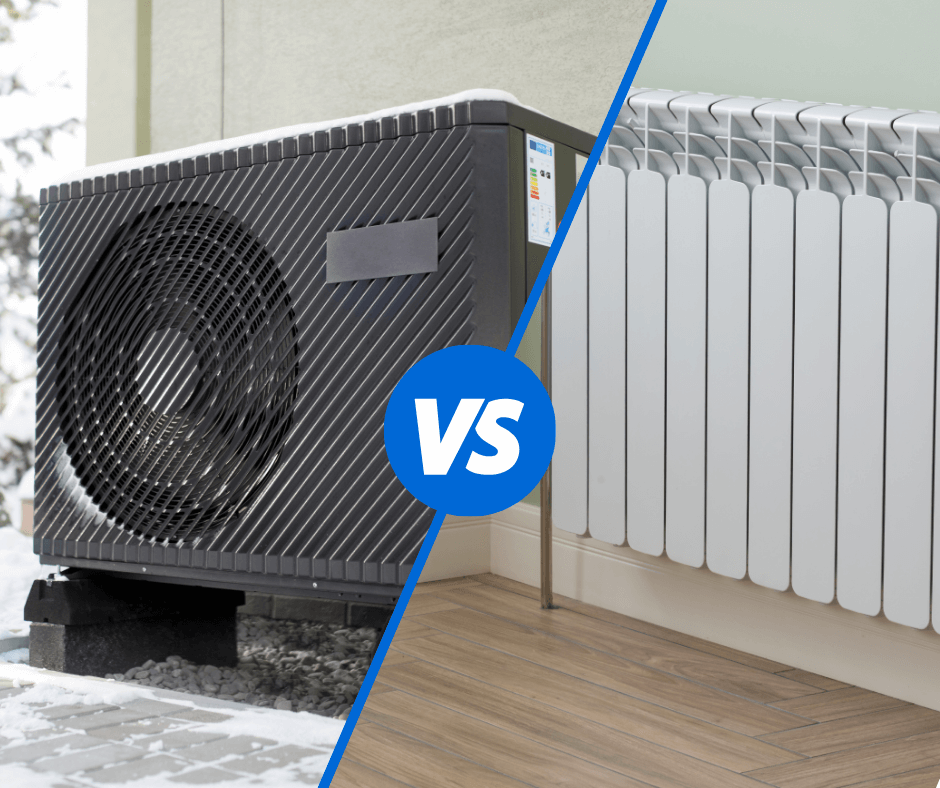
Choosing the right home heating system is essential for your comfort level and energy bills. If you’re hesitating between electric baseboards and other zone heating options like a wall or central heat pump, here’s why the latter might be your best option.
Do wall and central heat pumps provide both heating and cooling all in one?
Wall and central air conditioner systems are versatile, offering both a heating cycle in winter AND cooling in summer months. They work by transferring exterior wall heat inside during the colder months and expelling heat energy in the summer, providing optimal comfort throughout the year.
What are the features and benefits of a central heat pump?
The central heat pump with a heat accumulator is connected to a duct system to evenly distribute heat or cool air throughout the house. It offers:
- Energy efficiency: on average power, central heat pump systems consume up to three times less electricity than electric baseboard heaters thanks to their use of thermal energy, meaning the natural heat present in the air or ground. Instead of creating heat, they capture and redistribute it, offering much greater energy performance.
- Uniform comfort: thanks to its centralised distribution system, it ensures stable heating temperature for a smart home.
- Air quality: it often includes built-in air filters, improving air quality by removing allergens and dust.
- Longevity and maintenance: seasonal maintenance maximises its lifespan and keeps central heating performance high, making it a wise investment.
Why choose a wall heat pump system for heating and cooling your home?
The wall heat pump system is a practical and efficient heating and cooling system, particularly suited to homes or condos. It offers high heating and cooling capacity, ideal for the cooling season, and can complement a forced-air heating system. Its advantages include:
- Flexible installation: it doesn’t require complex ducts, making it easier to install in spaces without an HVAC system, while still providing better room heating.
- Year-round comfort: heat pumps provide a source of heat during colder months and offer an active and efficient cooling mode in summer, keeping a comfortable temperature in all seasons.
- Individual control: each wall-mounted indoor unit allows you to regulate heat distribution independently in each room, optimising comfort according to your specific needs.
- Energy efficiency: compared to electric baseboards, the heat pump consumes bit of electricity, reducing heating costs while improving comfort.
- Improved air quality: it is equipped with filters that purify indoor air, something baseboard heaters do not allow. Additionally, the operation of heat pumps ensures cleaner, fresher air circulation.
How to ensure optimal performance of your heat pump?
To ensure maximum efficiency and extend the life of your wall convectors and outdoor coil, regular cleaning is crucial. So, why clean your heat pump? Annual maintenance are essential for most heat pump models. Although electric heat pumps require more attention than simpler systems, this maintenance maintains long with the minimally invasive installation process to keep a high seasonal energy efficiency, ensures better indoor air quality, and guarantees optimal comfort year-round while keeping the multiple benefits of heat pumps.
What are the risks of clogged ducts in your heating system?
- Reduced efficiency
- Decreased lifespan
- Health and respiratory issues
- Poor heating/cooling performance
- Increased repairs and heating costs
Are electric baseboards a simple but costly heating solution?
Electric baseboards are individual heating systems for each room that convert energy into heat, with an easy electric heat installation environment and variable power depending on room size, and are affordable to purchase.
- Lower initial cost: baseboard heating has a lower upfront cost than ductless mini-split heat pumps.
- Localised temperature control: these electric heater systems allow precise temperature control room by room, helping to reduce the impact of air leaks by focusing warmth exactly where it’s needed.
- Quick heating: quality units heat up fast without needing a heat delivery system, offering immediate warmth.
- No duct needed: they don’t require ducts, making them ideal for homes without ducts or hard-to-equip spaces, and they help eliminate cold drafts by providing consistent, localized heating where it’s needed most.
However, despite being cheaper to purchase, we can find many cons of baseboard heating. They are more expensive annually in terms of energy consumption. For example, a 2.5 kW baseboard units can heat only one room. If you have 10 baseboards, you will need 25 kW to heat the whole house. In comparison, a electric wall heaters or other types of heating can heat an entire floor with just 3.3 kW. Baseboards thus present major disadvantages, particularly high energy costs and annual heating loads, which can result in significant utility bills, especially during cold weather and the heating season or with intensive electricity use. The heating coefficient of performance (CP) for this type of heating is therefore much higher for baseboards.
In short, don’t get fooled in the long run!
What is the daily consumption of an electric baseboard?
To calculate the kWh consumption per day for electric baseboard heating, you first need to know the wattage of your heater. For example, if your baseboard measures 6 feet (1.8 meters), using an average value of 250 watts per linear foot, its power would be 1,500 watts (6 feet x 250 watts).
Next, to convert this wattage to kilowatt-hours (kWh), divide the wattage by 1,000. In this example, 1,500 watts = 1.5 kW.
Finally, to know the daily consumption, multiply this power by the number of hours of use. If you use the electric baseboard heater for 8 hours a day, the consumption will be: 1.5 kW x 8 hours = 12 kWh per day.
This calculation can be adjusted depending on daily usage and the power of the baseboard.
What are the main disadvantages of electric baseboards?
- High energy costs: significant energy consumption and heat losses lead to high heating costs and elevated electricity bills. The heating power refers to the amount of heat needed to maintain a comfortable temperature – the higher it is, the more costs increase.
- Dry air: the operation of baseboards can dry heat out the ambient air, which may require adding a humidifier to avoid comfort issues like dry skin or wood cracks to avoid creaking noises. Additionally, baseboard heaters may generate a level of noise, which can be bothersome over time.
- Air quality: they do not filter the air, which can lead to dust buildup.
- Odor: when turned on or after a long period of inactivity, they can emit a burning smell caused by dust accumulating on the heating elements.
Why opt for a heat pump and what are its main advantages?
- Saving energy: an efficient heat pump consumes much less energy than electric baseboards, especially during low temperatures, thanks to its heating method, cooling power, and the use of programmable thermostats to optimize settings.
- Year-round comfort: they provide both heating in winter and cooling in summer, ensuring constant comfort.
- Environmental impact: their high energy-efficient performance, combined with the use of renewable energy, helps reduce the carbon footprint.
- Improved air quality: with built-in filters, they purify the air in your indoor units, something electric baseboard heaters cannot do.
- Non-dried air: unlike baseboard radiators, residential heat pumps keep the air pleasant and not dry – perfect for your family, especially if your children are sensitive to dry air.
What Canadian subsidy is available for installing heat pumps?
Several state programs, like Hydro-Québec’s LogisVert, offer subsidies for heat pump installation, making it more affordable to replace your heating system to face the Canadian climate. You could receive up to $6,700 in financial aid to cover your air handling equipment costs, allowing you to reduce your energy bills in the long term. Offer valid until December 31, 2024.
Why trust Duraclim?
At Duraclim, with over 10 years of experience and our double victory at the Consumer Choice Award in 2023 and 2024, we are proud to offer high-quality heating solutions. Our certified IQAQ technicians guarantee a professional and durable installation of your central or wall heat pump for assured comfort and savings!
Contact us for a free quote!
See also: How to maintain a heat pump?